
Introduction
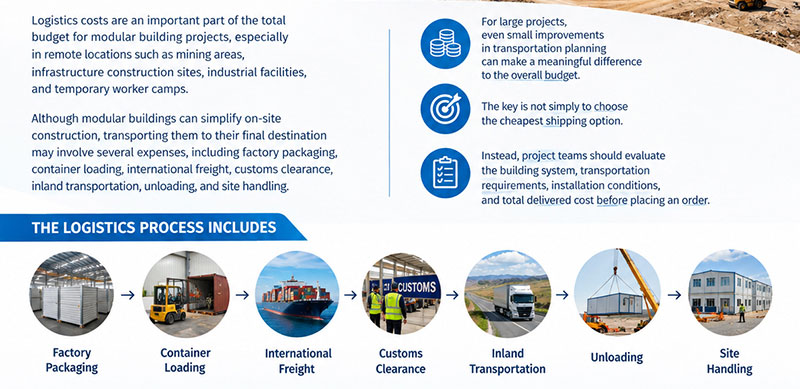
Logistics costs are an important part of the total budget for modular building projects, especially in remote locations such as mining areas, infrastructure construction sites, industrial facilities, and temporary worker camps.
Although modular buildings can simplify on-site construction, transporting them to their final destination may involve several expenses, including factory packaging, container loading, international freight, customs clearance, inland transportation, unloading, and site handling.
For large projects, even small improvements in transportation planning can make a meaningful difference to the overall budget.
The key is not simply to choose the cheapest shipping option. Instead, project teams should evaluate the building system, transportation requirements, installation conditions, and total delivered cost before placing an order.
This guide explains how to reduce logistics costs for modular buildings in remote projects and what buyers should consider when working with a modular building manufacturer.
1. Understand the Main Factors Affecting Logistics Costs
Before selecting a transportation solution, buyers need to understand what determines the total logistics budget.
Transportation Distance and Destination
The distance between the factory and the project site directly affects transportation expenses.
However, distance alone does not determine the final cost. A project located near a major seaport may have different logistics requirements from one situated deep inside a mining region.
Common transportation expenses include:
- Transportation from the factory to the departure port
- International ocean freight
- Port handling and terminal charges
- Customs clearance and import-related charges
- Inland transportation to the project site
- Unloading and lifting equipment
- Additional handling or temporary storage
For remote projects, inland transportation and site access can represent a significant part of the logistics budget.
Buyers should therefore evaluate the entire transportation route rather than focusing exclusively on the international shipping quotation.
Building Dimensions and Shipping Volume
The dimensions and packaging method of a modular building affect how efficiently it can be transported.
Some building systems can be disassembled or folded into a more compact shipping configuration. Others require more space because their main structural components remain assembled.
Depending on the shipping method, transportation costs may be influenced by:
- Total packaged volume
- Cargo weight
- Maximum package dimensions
- Container loading efficiency
- Special handling requirements
- Restrictions on road transportation
For international projects, confirming the packaged dimensions and loading arrangement before ordering can help prevent unexpected transportation expenses.
Site Accessibility
Remote project sites may have narrow access roads, steep gradients, weak road surfaces, bridge weight restrictions, or limited space for unloading.
These conditions can affect vehicle selection, delivery schedules, and lifting requirements.
Before arranging transportation, buyers should confirm whether standard trucks can reach the site and whether cranes or other unloading equipment will be required.
2. Choose the Right Modular Building System
A suitable building system is one of the most important ways to improve transportation efficiency.
Different modular buildings have different shipping characteristics. The best option depends on the project location, required building configuration, transportation route, installation schedule, and expected reuse.
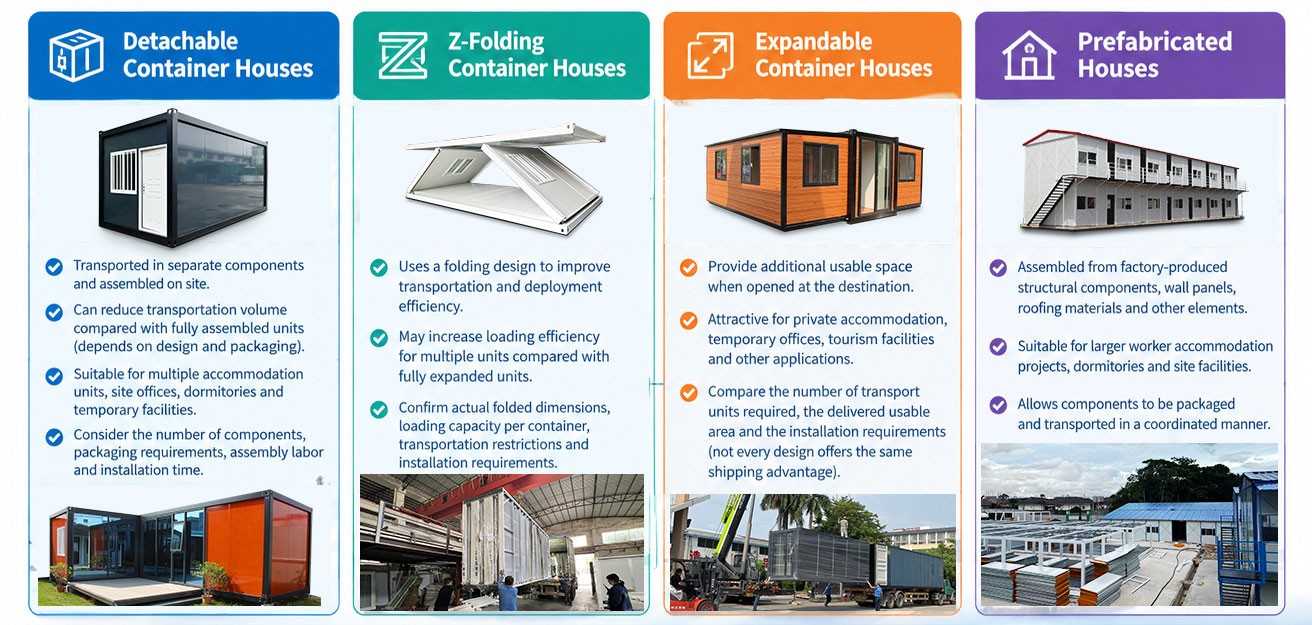 ]
]
Detachable container houses are designed to be transported in separate components and assembled at the project site.
Their disassembled configuration can help reduce transportation volume compared with shipping fully assembled buildings, depending on the design and packaging arrangement.
They can be suitable for projects requiring multiple accommodation units, site offices, dormitories, and temporary facilities.
However, buyers should also consider the number of components, packaging requirements, assembly labor, and installation time.
Z-folding container houses use a folding design intended to make transportation and deployment more efficient.
For projects requiring multiple units, the folding configuration may help improve loading efficiency compared with transporting the same number of fully expanded units.
Before selecting this option, buyers should confirm the manufacturer's actual folded dimensions, loading capacity per container, transportation restrictions, and installation requirements.
Expandable container houses provide additional usable space when opened at the destination.
They can be attractive for private accommodation, temporary offices, tourism facilities, and other applications requiring a larger interior area.
Buyers should compare the number of transport units required, the delivered usable area, and the installation requirements rather than assuming that every expandable design offers the same shipping advantage.
Prefabricated houses are assembled from factory-produced structural components, wall panels, roofing materials, and other building elements.
For larger worker accommodation projects, dormitories, and site facilities, a prefabricated building system may allow components to be packaged and transported in a coordinated manner.
The best transportation solution is not necessarily the building with the smallest shipping volume.Buyers should compare transportation cost per usable square meter, installation cost, and total delivered cost.
3. Optimize Container Loading Before Shipment
Efficient container loading can help reduce logistics costs, particularly when purchasing modular buildings in large quantities.
However, loading capacity depends on the actual product design, packaging dimensions, cargo weight, container specifications, and applicable transportation restrictions.
Confirm the Loading Plan Before Production
Ask the manufacturer to provide a preliminary loading plan before production is completed.
The plan should include:
- Packaged dimensions of each unit or component
- Total package volume and weight
- Proposed shipping container type
- Estimated loading quantity per container
- Packaging and securing arrangements
- Loading sequence and unloading requirements
These details help buyers estimate the number of containers required and compare freight quotations more accurately.
Avoid Paying to Transport Unnecessary Space
Poor packaging or inefficient loading can result in unused container capacity.
A coordinated packaging plan can help make better use of available space while maintaining appropriate protection for structural frames, wall panels, doors, windows, and interior components.
Products should never be packed in a way that compromises structural integrity or cargo safety.
Coordinate Accessories and Building Components
A modular building project may require more than the main building structure.
Electrical components, plumbing materials, sanitary facilities, furniture, and installation accessories may also need to be delivered.
Where practical and permitted, coordinating these items within the overall shipping plan can reduce fragmented deliveries and simplify receiving at the project site.
The final arrangement should be confirmed with the manufacturer and logistics provider.
4. Plan International and Inland Transportation Together
For remote projects, international shipping and inland transportation should be planned as one integrated logistics process.
A low ocean freight quotation does not necessarily mean a low total delivery cost.
Buyers should compare alternative routes using the same cost categories.
Consider the following factors:
- Distance from the factory to the departure port
- Available shipping routes and transit times
- Destination port handling charges
- Customs clearance requirements
- Distance from the destination port to the project
- Truck availability and road restrictions
- Delivery scheduling and unloading capacity
For mining camps and large infrastructure projects, delivery coordination is particularly important because multiple buildings may need to arrive in a specific sequence.
A phased delivery plan can help reduce temporary storage, congestion, and unnecessary double handling.
5. Coordinate Shipping with Site Preparation and Installation
Transportation costs do not end when a shipment arrives at the project site.
If the site is not ready to receive the buildings, the project may incur additional storage, vehicle waiting time, rehandling, or rescheduling expenses.
Before shipment, confirm that the following arrangements are in place:
- Foundations or supporting platforms are ready
- Access roads can accommodate the delivery vehicles
- Unloading areas are available
- Cranes or forklifts are arranged where necessary
- Installation teams are prepared
- Building components can be stored safely if immediate installation is not possible
For large worker accommodation projects, the delivery schedule should be coordinated with the installation sequence.
Effective coordination between the manufacturer, freight forwarder, contractor, and site team can help minimize avoidable expenses.
6. Compare Total Delivered Cost Instead of Freight Price Alone
One of the most common mistakes in modular building procurement is comparing suppliers only by their product prices or shipping quotations.
A more reliable approach is to evaluate the total delivered cost.
A practical budgeting formula is:
Total Delivered Cost = Product Cost + Packaging and Loading + Transportation + Import and Handling Charges + Inland Delivery + Unloading + Installation
The exact cost categories depend on the agreed delivery terms, project location, and scope of supply. Some expenses may already be included in a supplier's quotation, so buyers should avoid counting the same charge twice.
Example: Comparing Two Transportation Plans
Suppose a project requires 20 modular accommodation units.
The following figures are hypothetical and are provided only to demonstrate the calculation method.
| Cost Item | Plan A | Plan B |
| Product cost | $100,000 | $100,000 |
| Packaging and loading | $4,000 | $5,000 |
| International transportation | $12,000 | $10,000 |
| Inland delivery | $8,000 | $6,000 |
| Unloading and handling | $3,000 | $3,000 |
| Total logistics cost | $27,000 | $24,000 |
| Total delivered cost | $127,000 | $124,000 |
In this example, Plan B costs $3,000 less overall, even though its packaging and loading expenses are higher.
The example illustrates why buyers should compare complete transportation plans rather than individual cost items.
For an actual project, all quotations should use the same shipment quantity, delivery destination, scope of service, currency, and agreed Incoterms.
7. Work with a Manufacturer That Understands Project Logistics
Choosing a manufacturer with experience in project-based supply can help buyers coordinate product selection, packaging, shipment planning, and installation requirements.
For large infrastructure projects, the supplier should understand that modular buildings are part of a wider site development plan rather than isolated products.
Before confirming an order, buyers should ask the manufacturer:
- Can you provide packaged dimensions and a loading plan?
- Which building systems are suitable for our transportation route?
- Can building components and accessories be delivered together?
- Can shipment schedules be coordinated with our installation plan?
- What installation guidance and technical documentation are available?
- Which logistics costs are included in the quotation?
For projects requiring worker accommodation, offices, sanitation facilities, and other supporting buildings, coordinating multiple product categories through one project supply plan may simplify procurement and delivery management.
At Moneybox House, our product range includes detachable container houses, Z-folding container houses, expandable container houses, prefabricated houses, portable toilets, and steel structure buildings. These solutions can be considered according to project requirements, site conditions, and transportation arrangements.
The appropriate configuration should be evaluated individually for each project.
Frequently Asked Questions
1. What is the biggest factor affecting modular building logistics costs?
The main factors include shipping volume, cargo weight, transportation distance, route availability, loading efficiency, destination handling, and inland delivery. For remote projects, site accessibility and unloading requirements can also have a significant impact.
2. Which modular building type is the cheapest to transport?
There is no universally cheapest option. Detachable, folding, expandable, and prefabricated building systems have different packaging and transportation characteristics. Buyers should compare actual shipping configurations and total delivered costs for the required usable building area.
3. How can I estimate shipping costs before placing an order?
Start by confirming the product model, quantity, packaged dimensions, total cargo weight, destination port, final delivery address, and proposed shipping method. Request a detailed quotation covering the relevant transportation and handling charges.
4. Can modular buildings be shipped with furniture and accessories?
In many cases, furniture, electrical materials, plumbing components, and other accessories can be included in the overall shipment. The arrangement depends on available space, cargo weight, packaging requirements, and applicable shipping regulations.
5. How can remote mining projects reduce additional delivery expenses?
Plan transportation and installation together. Confirm road access, site readiness, unloading equipment, storage arrangements, and the delivery sequence before dispatch. These steps can help reduce waiting time, rehandling, and unnecessary storage.
6. Should I choose the lowest shipping quotation?
Not necessarily. Compare the complete scope of each quotation, including handling, customs-related charges, inland delivery, unloading, transit time, and any excluded services. A lower initial quotation may not produce the lowest total delivered cost.
Conclusion
Reducing logistics costs for modular buildings in remote projects requires coordinated planning from product selection through final installation.
The most effective measures include choosing an appropriate building system, optimizing packaging and container loading, comparing complete transportation routes, preparing the project site before delivery, and evaluating total delivered cost instead of freight price alone.
For mining camps, worker accommodation, infrastructure projects, and remote industrial facilities, early coordination between the buyer, manufacturer, and logistics provider can help improve budget control and delivery efficiency.
If you are planning a modular building project, **Moneybox House can help you evaluate suitable building systems and project supply requirements** based on your intended application, estimated quantity, destination, and installation conditions.
Contact our team to discuss your project and request a tailored quotation.


 Servizio Online
 +86-020-34800775+8618818900230
 export@moneyboxhouse.com
 +8615920397177
 1198017314
 italiano
  English
 español
 français
 Deutsch
 русский
 português
 Nederlands
 Ελληνικά
 हिन्दी